

PLASTICBUG studies how tmicroplastics in the environment can carry harmful bacteria, including those resistant to antibiotics, through freshwater systems and along the food chain. Although microplastic pollution is now widely recognized, its role in spreading antimicrobial resistance is still not well understood.
By combining fieldwork with controlled laboratory experiments, the project recreates realistic environmental conditions to better understand how microplastics interact with microorganisms. It explores how these particles can host and transport resistant bacteria, how long these microorganisms persist in aquatic environments, and how they can be taken up by plants and animals and passed along the food chain.
From the formation of microbial communities on microplastics to their ingestion by living organisms, PLASTICBUG examines the potential environmental and health impacts of this process. Special attention is given to bacteria that pose risks to public health, as well as to the combined effects of microplastics and microorganisms within a One Health perspective.
Ultimately, the project aims to generate knowledge that helps assess risks, supports informed decision-making, and contributes to strategies addressing both plastic pollution and antimicrobial resistance.
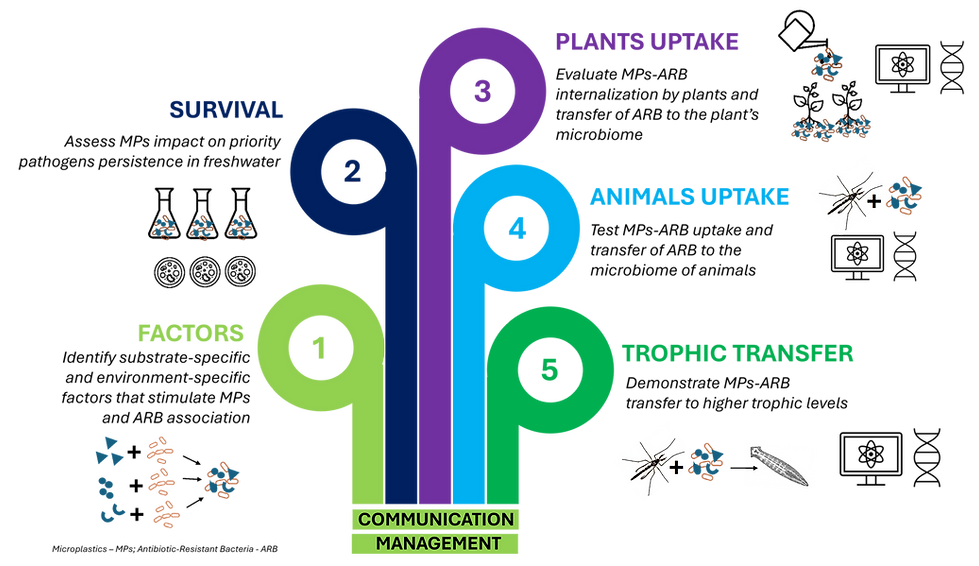
WORKFLOW
01
What drives bacteria to attach to microplastics?
This task explores why and how bacteria, including those resistant to antibiotics, attach to microplastics. By combining field studies and laboratory experiments, we will identify which types of plastics and environmental conditions favour this process.
03
Can plants take up microplastics and bacteria?
This task studies whether edible plants can absorb microplastics carrying bacteria, and whether these microorganisms can become part of the plant microbiome, potentially affecting plant health.
05
Can bacteria move along the food chain?
This task looks at whether bacteria carried by microplastics can pass from one organism to another through feeding, moving up the food chain and potentially reaching higher organisms.
07
Project coordination
This task ensures that all activities are well coordinated, monitored, and completed on time, supporting the overall success of the project.
02
Do microplastics help pathogens survive?
This task investigates whether microplastics can help harmful bacteria survive for longer in freshwater environments, potentially increasing their chances of spreading.
04
What happens when aquatic organisms ingest microplastics?
This task examines how small aquatic animals ingest microplastics and whether the bacteria attached to them can enter and affect their microbiome and overall health.
06
Sharing knowledge and raising awareness
This task focuses on communicating project results to different audiences, raising awareness about microplastic pollution and antimicrobial resistance through educational materials, events, and stakeholder engagement.
TASKS
